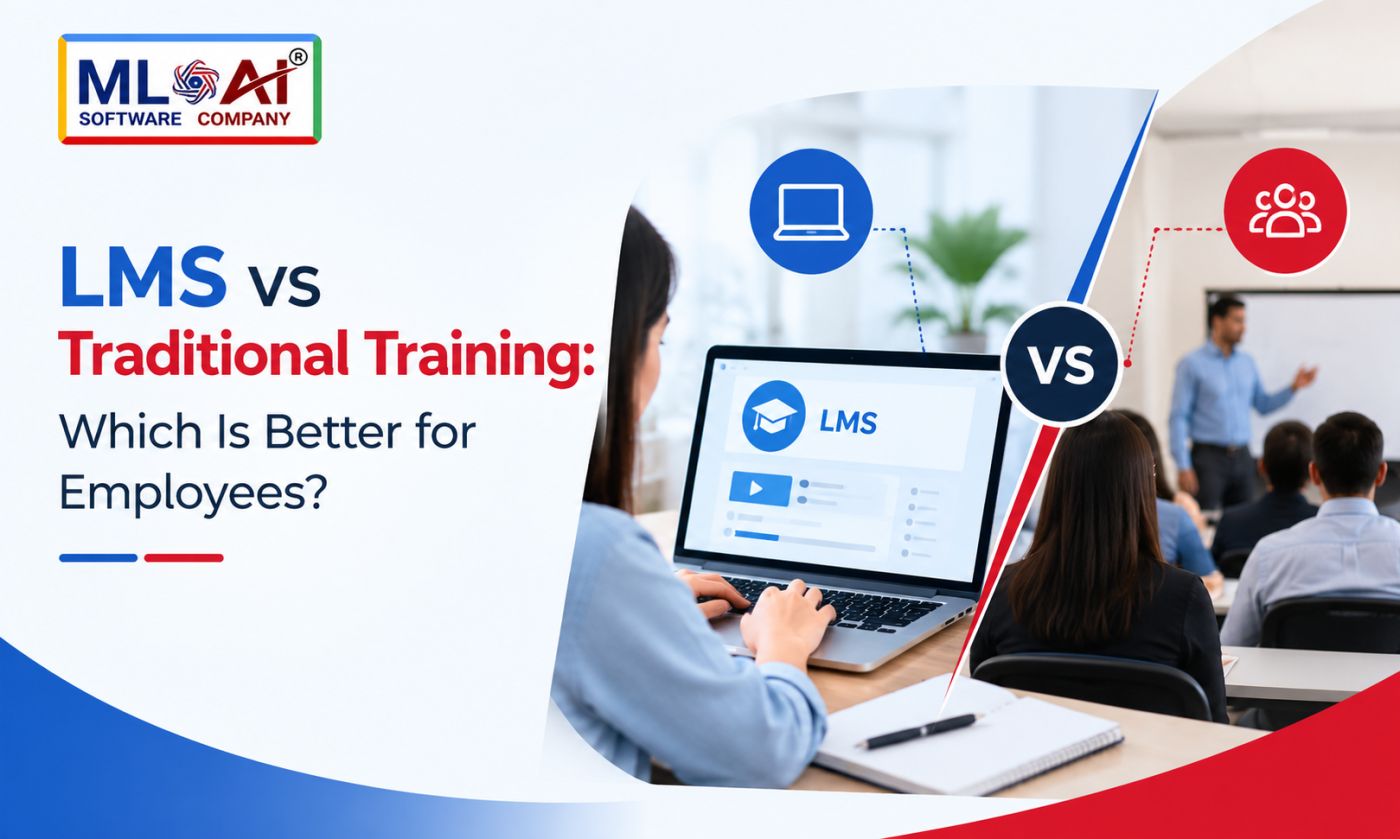
Employee training has changed significantly. Earlier, most organizations depended on classroom sessions, printed materials, fixed schedules, and trainers to deliver learning. While traditional training still has its place, businesses today are managing larger, distributed, and hybrid teams. This has created a growing need for more flexible ways to train employees.
So, when comparing LMS vs traditional training, which approach is better?
The answer depends on the type of training, workforce, and business goals. However, for organizations that need consistent, trackable, and scalable employee learning, a Learning Management System (LMS) can offer clear advantages.
Also, Read more here - Use of Learning Management System in Healthcare
What is Traditional Employee Training?
Traditional training usually involves an instructor conducting a classroom session, workshop, seminar, or practical demonstration. Employees attend at a scheduled time and location, interact directly with the trainer, and often receive printed or digital learning materials.
The biggest advantage is human interaction. Employees can ask questions immediately, participate in discussions, and learn through practical demonstrations. This can be particularly useful for hands-on skills, leadership workshops, or activities where personal interaction is important.
However, traditional training can become difficult to manage when employees work across different locations or when the same training needs to be repeated for multiple groups.
Also, Read more here - LMS for Retail: A Complete Guide to Employee Training
What is an LMS?
A Learning Management System is a digital platform used to create, deliver, organize, and track employee learning. Employees can access courses, videos, assessments, and other learning resources through a centralized system.
An LMS can also help HR and training teams monitor course completion, assessment performance, and employee progress. This makes training easier to manage and gives organizations a clearer view of learning activities.
For businesses exploring a Learning management system in India, flexibility and scalability are particularly useful when employees are spread across different cities, offices, or work environments.
LMS vs Traditional Training: Key Differences
1. Flexibility
Traditional training generally follows a fixed schedule. Employees need to be available at a particular time and place.
An LMS allows employees to access assigned learning according to their availability. This makes it suitable for hybrid teams, remote employees, and organizations with multiple locations.
2. Training Consistency
With classroom training, the experience can sometimes vary depending on the trainer, location, or group.
An LMS allows the same approved course material to be delivered to employees across different teams and locations. This helps organizations maintain a more consistent training experience.
3. Progress Tracking
Tracking traditional training often involves attendance sheets, emails, spreadsheets, or manual follow-ups.
An LMS can record course progress and assessment results digitally. Managers can use this information to identify incomplete training and understand where employees may need additional support.
4. Scalability
Training a small group in a classroom may be straightforward. But repeating the same session for hundreds of employees can require additional trainers, venues, schedules, and coordination.
Digital learning can be delivered to a much larger workforce without repeating the physical setup for every group.
5. Employee Engagement
Traditional training has the benefit of direct human interaction, which should not be overlooked.
At the same time, an LMS can support videos, quizzes, assessments, self-paced courses, and other digital learning formats. The right approach depends on the subject and how employees learn best.
Also, Read more here - What is an AI-Based Learning Management System?
Is LMS Better than Traditional Training?
Not always. In many situations, LMS vs traditional training should not be treated as an either-or decision.
For example, employees could complete an online compliance course through an LMS and then attend an instructor-led workshop for practical training. This blended approach combines the convenience of digital learning with the interaction of classroom sessions.
Traditional training remains valuable when practical demonstrations, group discussions, or face-to-face coaching are essential. An LMS becomes especially useful when businesses need flexible access, centralized content, progress tracking, and consistent training at scale.
How MLAI LMS Supports Modern Employee Learning
MLAI LMS provides a digital approach to managing organizational learning. Businesses can use an LMS platform to organize training content, assign learning activities, monitor employee progress, and create a more structured learning environment.
For organizations searching for a Learning management system in India, the important consideration is not simply choosing a digital platform. The system should fit the company's training goals, employee needs, workflow, and future growth.
Frequently Asked Questions
Q1. Is an LMS Better than Traditional Employee Training?
Ans. An LMS is generally more suitable for flexible, scalable, and trackable learning, while traditional training remains valuable for interactive and hands-on sessions. Many organizations benefit from combining both.
Q2. Can an LMS Replace Classroom Training Completely?
Ans. Not necessarily. Practical training, workshops, and leadership sessions may still benefit from face-to-face interaction. An LMS can complement these activities rather than completely replace them.
Q3. Why do Companies Use an LMS for Employee Training?
Ans. Companies use LMS platforms to centralize training, provide flexible learning access, track progress, and simplify training administration.
Q4. What Should Businesses Consider Before Choosing an LMS?
Ans. Businesses should consider ease of use, course management, assessments, reporting, employee accessibility, scalability, integrations, and whether the platform fits their specific training requirements.
Final Thoughts
The choice between digital and traditional learning should be based on what employees actually need. LMS vs traditional training is less about choosing one winner and more about finding the right balance.
For organizations with growing or distributed teams, an LMS can make employee learning more organized, measurable, and accessible. At the same time, traditional training continues to offer value where personal interaction and practical learning matter most.
A thoughtful combination of both can create a training environment that is flexible for employees and manageable for the organization.